


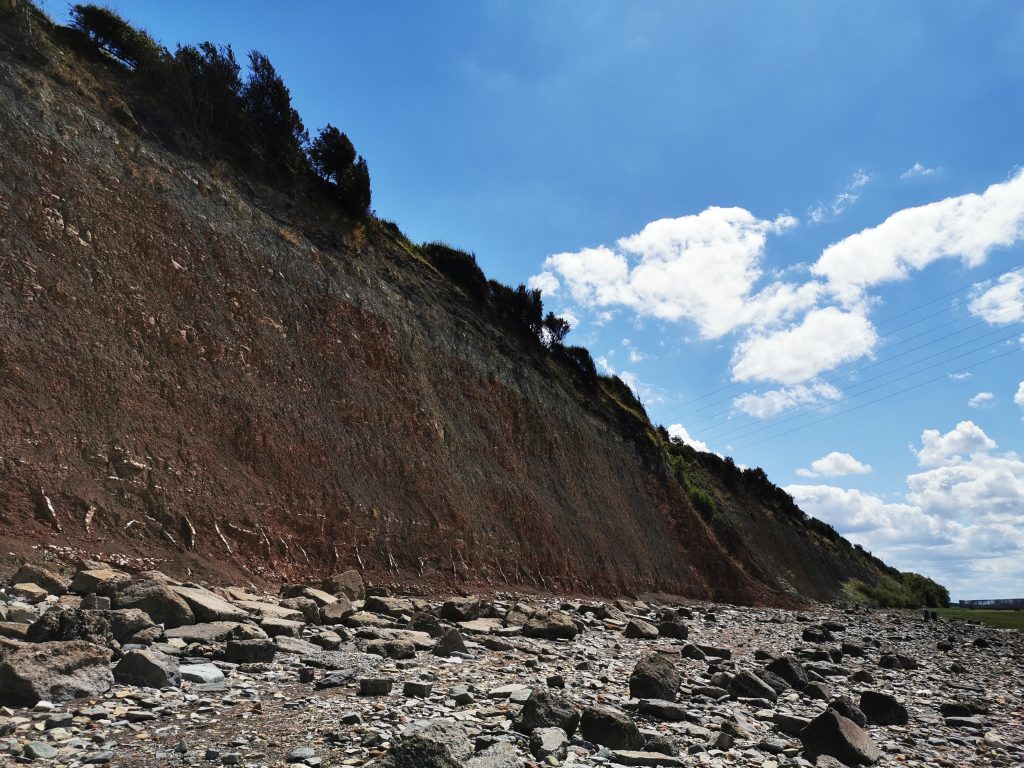
Just over the original Severn Bridge, the border between England and Wales, rise the Aust Cliffs in all their multicoloured magnificence. Discovered on a walking trip over the bridge in order to capture the fascinating wave motions of the Severn (see the video below), these astonishing cliff-faces captured our attention just as much as the magnificent bridge that has spanned the estuary since 1961.
The red-coloured cliffs – topped off with grey with a very straight edge delineating the two – is of mudstone rock formed during the Triassic Period, at time when Aust was situated near the equator with the climate of a hot desert.
The excellent website “A Forgotten Landscape” explains:
The upper layers of the cliff look much darker but with jagged, yellow pieces of rock sticking out – they are made up of a mix of limestone and mudstone layers that formed in shallow, tropical seas 210 million years ago. This layer contains the fossils of sea reptiles such as ichthyosaurs and plesiosaurs. Their bony remains, along with those of fish such as sharks and the remains of shells and sea urchins can be found on the beach below, washed down by wind and rain. The Rhaetic bone bed at the top of the section of cliff, is regarded as the best site for marine reptiles in Britain.
As well as being internationally significant for reptile fossils (it’s one of the most productive locations in Britain), Aust Cliff is nationally important for fossils of insects from the Triassic period. Several new species of mecoptera (scorpion flies) have been described from Aust. The specimens generally occur in concentrated blocks of the Rhaetic limestone from the top of the section with a high proportion of complete bodies, some even with their colour and patterning preserved.
The cliffs are best viewed from the bridge on the south side, approaching Aust from Chepstow. Needless to say, many reference pictures were taken, inspiration for Mike’s ceramics which he is now feverishly experimenting with in his new studio.
Then of course, there was the watery patterns stirred up by the muddy banks of the Severn, captured by Lance on HD video – again for reference and possible future use in installations. The movement of the water gave rise to much discussion about the nature of waves, in light of reading an excellent book blogged about some weeks back. A fair amount of footage was captured, but the edited highlights can be seen below. The swirling liquid was quite hypnotic; unlike the rush of a river or the swell of seawater, it moved almost in slow motion, causing thick ripples and plateaus that moved and changed on the face of the water.
The trip to the Severn Bridge and Aust Cliffs proved more useful than we could have imagined and will no doubt be the subject of further investigation. It was the perfect combination of earth and waves – exactly what Earthwaves is all about.
