



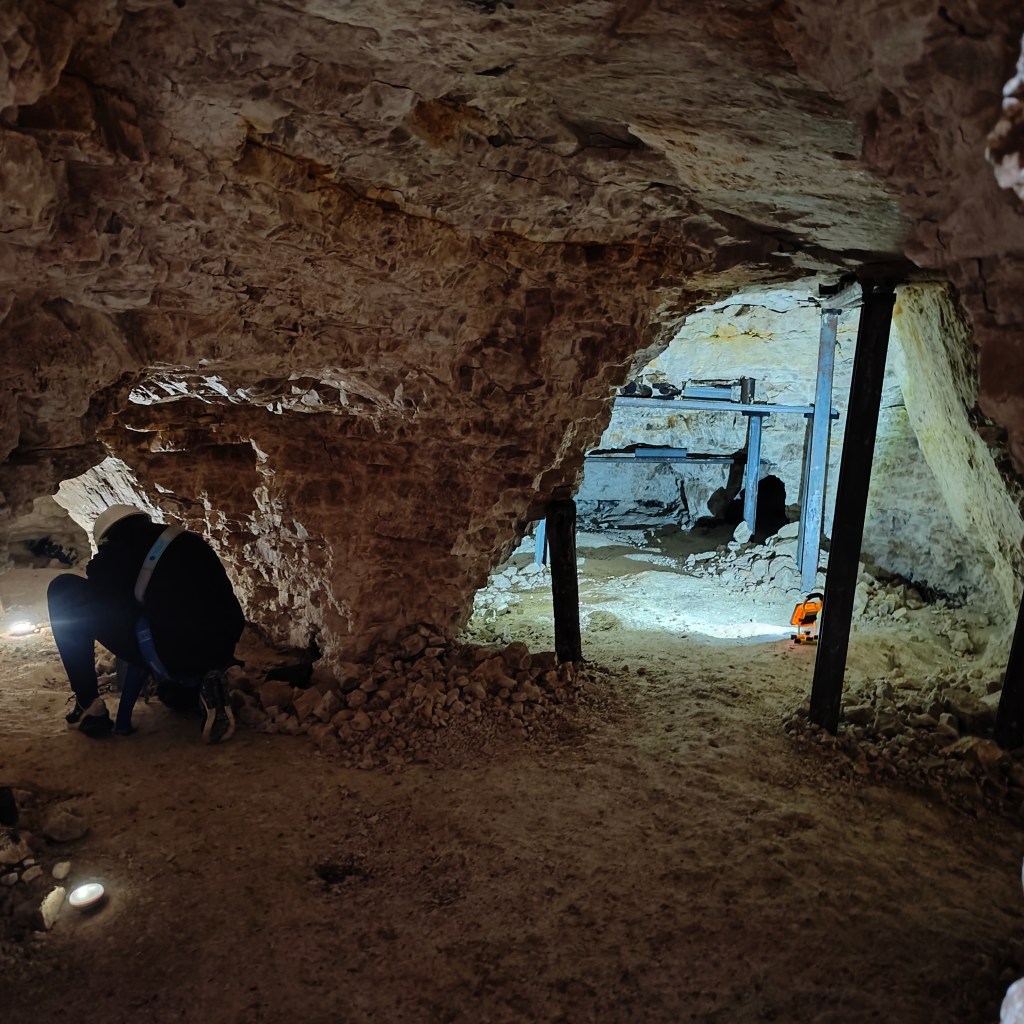
When visiting a Neolithic flint mine you get up close and personal to the mysteries of flint. Grimes Graves flint mines in Norfolk run by English Heritage is not what you might think. Pretty unprepossessing is both the reaction to the brown signs we’ve driven past of the years, to the photo of the lumpy land. Sure a chalk pit dug for flint sounds a bit dull, until you meet the experts. Mike also had the good fortune to make a special visit to the deepest pit so harness, and hardhat were the order of the day.


When you look at a chalk pit it is striking because it has different layers of flint, not unlike seams of coal just more modest deposits of flint. It is extraordinary that the chalk if from minute algae which have combined water soluble calcium with carbon dioxide in the air and when dead fallen to the sea floor. The amount deposited over many tens of millennia is extraordinary, and at Grimes Graves finishing with the last of the dinosaurs. This is a great way to store greenhouse gas carbon from the atmosphere. But the flint is actually from silica, i.e. sand and from the structures of sponges and other organisms. Like glass, but actually not quite, chemically yes, structurally at a molecular level not, seemingly crystalline but not, containing water, which is odd, and porous which is a great surprise. It chips like you might expect a crystal, and of course its properties were exploited and created the Stone Age. This was a hugely important phenomena, in developing a very sophisticated early human culture on which our own has been able subsequently to develop. It is the longest period of human culture. In fact stones were so easy and simple to use that even in the Bronze Age people were still preferentially using it for tools and weapons. Its true iron did finally surpass its use, although still used in places like Norfolk as a building material.Yet in spite of this importance geologists still are not completely clear why flint was deposited in the way it was or quite what is it yet in its fullest detail.

Knowing how important flint was in Neolithic times, it is quite something to see how a mine worked. Even more fun was to be had in tunnels made by Neolithic people, touching the actual antlers they used to mine the flint from the chalk rock, and see flint remnants left by them. Its even possible to look through tunnels that break through to other pits tunnels networks, and in one instance to see a space which has been just left by the Neolithic miners. It may of not been Tutankhamun tomb, but to Mike lying on my stomach with a hard hat on, phone torch in hand, it was still quite a rush.

The more you get up close to Neolithic archaeology and listen to real experts the more you get excited about the mysterious lengths people went to when actually the practical are not the reason. The extensive Grimes Graves mines were neither really needed for practical purposes. Flint to use for tools is not difficult to find. Deep pit mines not necessarily. Also these mines were 1,500 years after the use of more shallows excavations for flint on the site. So like Stonehenge and other stone circles it is difficult to see why people spent unbelievable amounts of time on an activity without apparent practical value in a place seemingly away from essential like water in a bit of Britain which was not exactly central as far as chalk deposits go in the south east. The earlier flint mines on the south coast make much more sense from a functional and ease of collecting mining perspective.
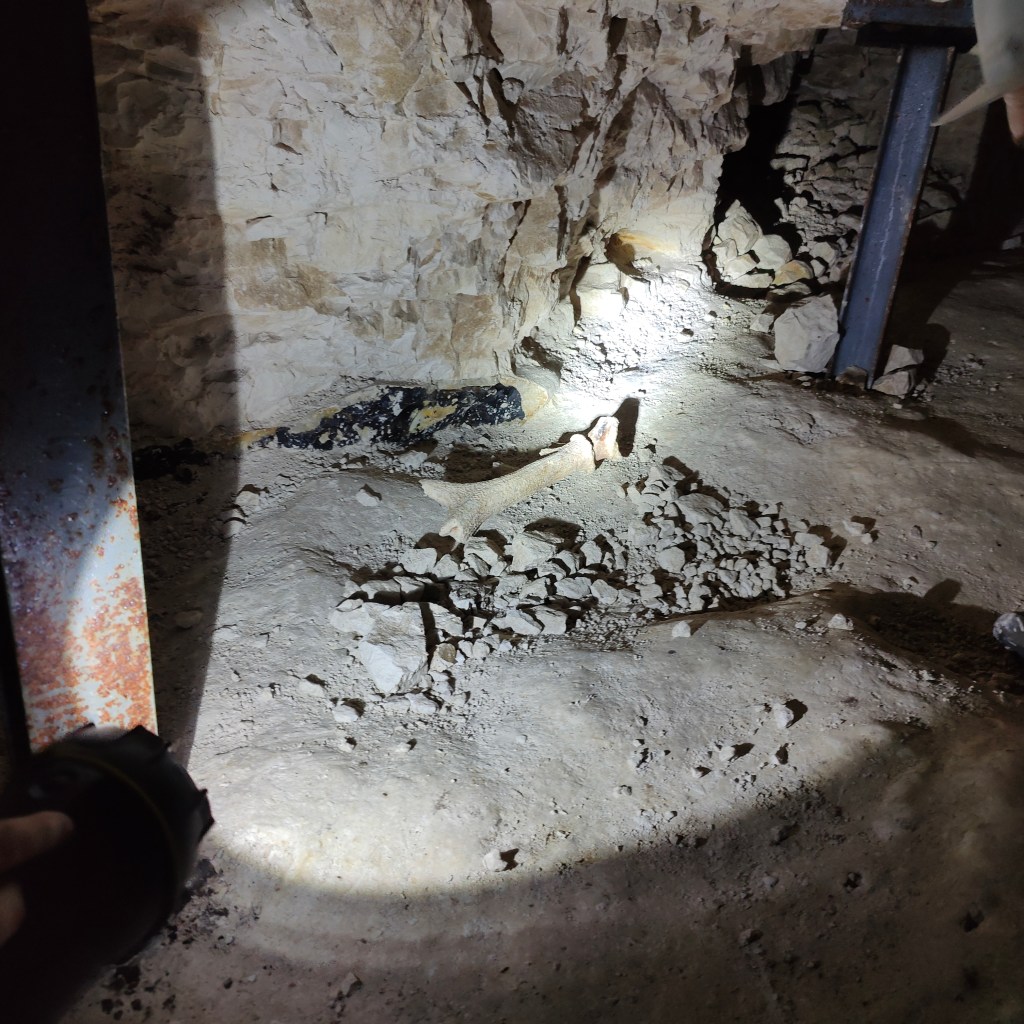
Even more mysterious is what happened to the flint. Its not on site, and there’s not much evidence where it travelled to, other than polished axe heads and the like, of which this dark uniform flint might have been good at producing. Polished stone axes are all over the place and seem to be something widely traded. Certainly at the Grimes Graves mines flint was mined and then knocked into rough shapes ready for making tools, but looks like the polishing was done elsewhere. Polishing takes 200 hours per axe head and needs water, perhaps one month of work by today’s employment contracts. Water is not obviously found at Grimes Graves as there is no river so polishing seems to be done elsewhere. With the first significantly later pits dug down to the floorstone layer of flint, the third layer down, its seems that whoever’s initiative to camp there summer after summer, seem to know the floorstone layer would both be there and deeper was better. However, from a functional perspective, well demonstrated by the wonderful video at the English Heritage visitor centre at Grimes Graves, that polishing an axe for 200 hours wasn’t necessary to make a very effective tool. Flint tools wear out like any tool, and knapping a quick replacement would have been why stone tools were so appealing, no trek to the hardware store or reliance on internet shopping. It was a considerable skill but proabably a skill everyone had. So mystery again for the purpose of the mines.
The mining knowledge needed for the mines, based on the archaeological evidence, inevitably suggests that people travelled from Europe with flint mining expertise, mines in places like Poland are well well studied and easy to visit. Perhaps our more recent years of Eastern European people travelling for work in the summer is not so modern after all. Longer ago than perhaps many of us who feel they’re lineage is in Britain. That would rather turn some of the hideous modern racism about Europeans coming to work, evident with Brexit, on its head. But given the trade on polished axes across Europe perhaps it was more like minting your own money. Just you polished stone rather than struck a coin.
But to try and find a modern metaphor for polished and unpolished tools, Normal knapped flint tools is a bit like buying a shovel at the local hardware store, except you probably made your own, as opposed to buying a gold one with diamond tipped blade edge from a specialist miles away, that happened to be trading in your area. Of course to my knowledge there is not much call for gold shovels. Hence the mystery and that the purpose and value of a polished axe, in flint stone or otherwise, hardly seem likely to be functionally used, given the huge amount of effort required, in an age when even if living simply, you had no mod cons or convenience living, or in Neolithic times even much evidence of slavery then, much more evident later of course. If you multiply 200 polishing hours by the minimum wage it works out as £2,288 which would be a rather expensive shovel! And then you have to add the mining cost which adds yet again. What a very prestigious shovel that would be, a Rolls Royce of shovels. Ah perhaps that the clue, why do people own a Rolls Royce or very expensive car?
So in the next few weeks we get to visit when we attend the Flint Festival and get close up and personal with flint. Thanks to the English Heritage team at Grimes Graves flint mines for another excellent members visit, a friendlier and a more knowledgeable bunch with a very warm welcome would be hard to find.