

The 1970s seems to get a bad press generally, when actually it was a blossoming of the 60’s opening up to creativity. Mike really grew up in that era, and was witness to all that was evidently experimental was so evident, and he can recall when he first encountered innovative and immersive. Much of that magic seems to be lost with later art, the emphasis being on commercial money making tech and so-called reality experience in either gaming or digital effect cinema, even realism. I don’t think the “bad boys of British art”, Hirst et al, post-artist businessperson did art any favours in the long run; they appeared to be purely interested in commoditising and downgrading work, even if the original “sensation” exhibition works were of a high quality. Its difficult to find modern art work that really wows in our view if we have to be honest. Perhaps our visual and music preoccupations misleadingly makes us believe our world in only visual and sound. When we want new experiences or even pretend we are something else, we seek alternative visual and sound worlds. Add social digital interaction and people disappear down the wormhole of escapism.
You might think that Anthony McCall’s wonderful yet simple light sculptures from that ’70s era were just early versions of escapism into an immersive experience, but you would be wrong. The best quality art in our view seems to embody a deeper level of an artist’s inner self; expressible and explored in many ways, never just a repetitive, quickly churned out product. Usually there will something intuitive going on, not intellectually thought out but there for the audience to explore in their own stimulated imagination. There are not many artists that can achieve this last stage and we perhaps only aspire to that in our work together. Yet McCall, who in those early days was perhaps not recognised for his ability to achieve this second level of work for an audience, is now being reappraised by Tate Modern in the retrospective of his extraordinarily engaging projected light works.

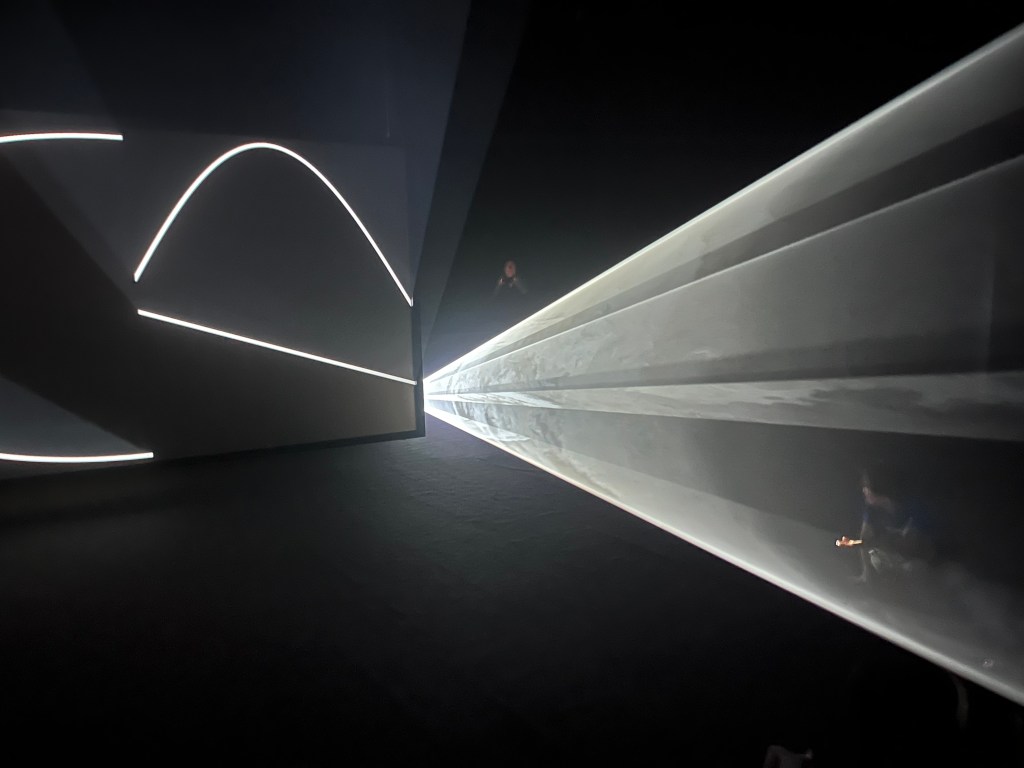
The sculptures in McCall’s ‘Solid Light’ series of works are single source projection using white light radiating outward. These works are presented in a blackened room, maximising the full effect of the beams in stark white with unexpected colour generated from moments caught in the light of audience walking through the light sculptures. These are apparently, as you enter the space, static light cones. Then you realise they exist only because of the mist in the room, creating moving patterns on the flat planes of the cone shapes which are hollow. For each sculpture you see the curved lines and arcs that are being projected on a target wall for the projection.
Its seems that the technology could be quite simple, although probably more sophisticated to achieve the crispness, degree of safe brightness and tolerable room mist. The use of projection perhaps a fascination any schoolchild might have or even make in their bedroom – as Lance can attest to! It is a fascination that we very much have today and try and bring into our work, less successfully that perhaps we would like with the affordable technology we have at our disposal. Yet I think that we would be wrong, much as we would be wrong to think we could daub paint like De Kooning. These artists bring a second level and also one that is lasting in its magic.

So you immerse yourselves in these sculptures and the experience is quite transformative as well as playful. It is very accessible work but the audience is enraptured, engaged, fascinated, experiencing perhaps something not quite tanglible or describable, an inner experience too. This is not the flatness and all too often overblown coloured detail of the digital world. This is much more visceral. You are in it, you watch yourself interact with the light, very present , and wakefully conscious not just in that world of visual sound and imagination. In fact the only sound is human, although the audience were very quiet in this gallery, caught up in their exploration and fascination.
Needless to say it has brought new life to our thinking with our projection work, perhaps allowing us to shift more to that next level, simplicity from the creative complexity.