
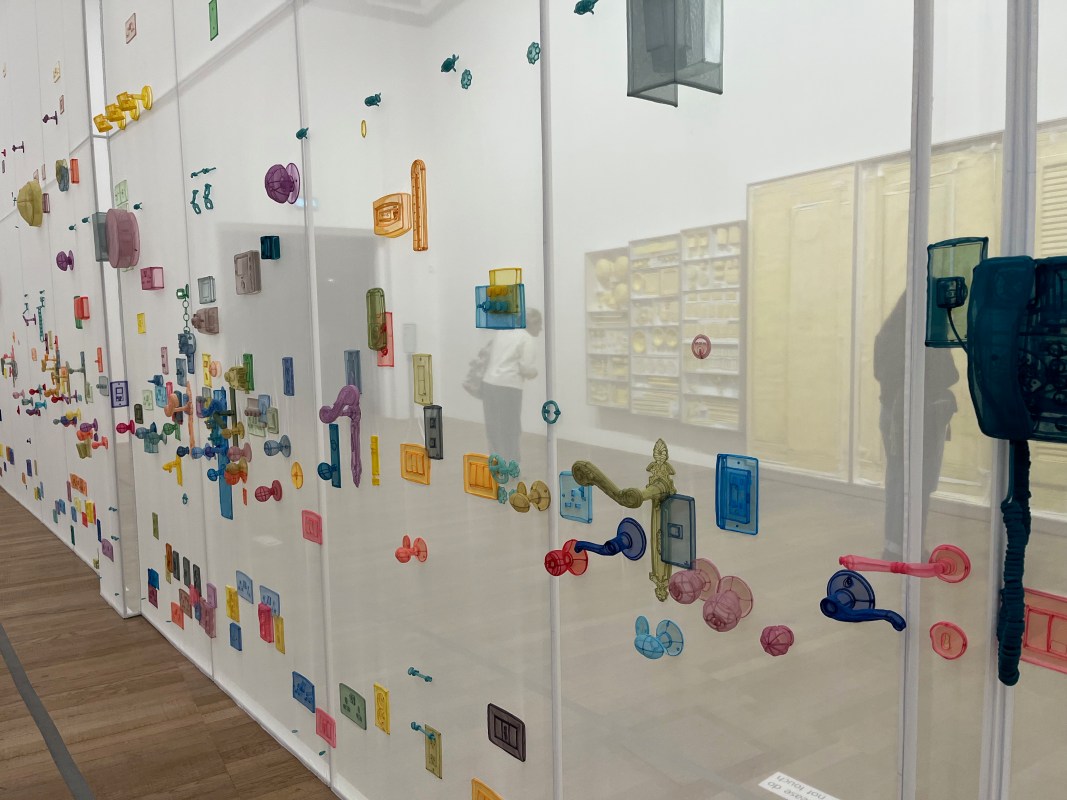
‘Home’. An interesting word that brings forth a multitude of sometimes amorphous meanings. Is ‘home’ a building, a country, a state of mind? It is a word often used in conversation. Phrases like “make yourself at home” and “this is your home from home” are common. The multiplicity of meanings linked to the word is subtle and shifting, and is as individual as every human being on the planet.
With this borne in mind, Lance and Mike went to the Do Ho Suh exhibition: Walk the House at Tate Modern, which explored these very notions of ‘home’. Mike had seen Do Ho Suh’s work before and loved it but “was not expecting to be blown away by the wonderful conceptual elements of the art which had not struck me before.” Lance was new to the artist, but found the experience and the very breadth of the ways in which these themes are explored through the rather monumental pieces reconstructed at the Tate incredibly inspiring.
The first half of the exhibition, the bit with the biggest wow, was about what makes a home; when one moves, what aspects you physically might take with you and what you take with you as memories. The art begs the question what is home, what layers of experience in a building or space are significant. With Lance currently considering a move to a new area, this proved a great exhibition to extend his thinking about what a new home would be.
We could take you through the exquisite detail of this work, but these are best seen first hand. The variety and use media though is worth noting. Paper can be used to capture a building in full size. The art process involved taking rubbings of doors, walls, windows, and so on. This process was found meditative by the artists when blindfolded. The reconstructed work, using colour translucent net on wire frameworks is a wonderful representation of the memory of home we take with us when we move. The work is a crossover between architecture, paper based work and creation with fabric. The paper provides a template for cutting fabric pieces in their real scale. The artists also explored working with sewing on paper, sewing on dissolvable paper and sewing gelatine in 3D and allowing it to squash into 2D. Mike: “I realised that my sewing machine work, mainly practical, could be used beautifully to extend the stone circle landscape work. I already am using textile for a wall hanging, and developing my felting skills, but the conceptual aspects of the exhibition help me translate my fabric skills and tools nicely into the core of our neolithic investigation”.
Our Neolithic work is not so much about personal or family home, but more about a community’s home embodied in the ‘spiritual’ building of stone circles. These circles are built by a culture which has many layers; medicine, understanding the movement of planets and stars, celebrating and ritual. We believe there existed some kind of deeper spiritual experience in the circles they create. However, there will be more on that aspect later as our work develops.
As the cultures change with migration through Europe to Britain so the monuments change and develop with new and different layers of meaning to a community monument. But the big mystery is why did a group of people move a bluestone circle from West Wales to Salisbury Plain, and then stay there. It seems to us it is the notion of community home that the stone circle embodies, which means for these people the stones themselves have to be moved with them to keep the aspects of community home authentic. Recreating with new different stones, or even just keeping the memory alive of an old stone circle was not enough! Using our art investigation to explore the layers of what might be the significance of the community home is very much at the heart of the Neolithic landscape for the Earthwaves partnership. Do Ho Suh’s work inspires us to take that that art process further.
The second part of the Do Ho Suh exhibition was an interesting use of digital media and drawing, however less inspiring. The architectural work of bridging Seoul, New York, and London to place a new home, it seems in the Arctic, was personal and fanciful, presented as some kind of solution in the need to move continents, and perhaps issues of immigration implicit, but not sustainable as a solution. Perhaps we already have too much of that in the real world, billionaires getting rich to refabricate the world as they personally want it irrespective of the real damage and exploitation this involves of everyone else let alone the impact on the planet. Mike: “I used to draw lots of architectural fantasy when I was a boy, irrespective of cost or impact on others or the environment, so this second part of the exhibition had this boyish naïve resonance for me”. Yet even so the big ideas in the exhibition were rather resonant of the big idea to move a huge stone circle to Salisbury Plain from South Wales.
The other aspects which were mentioned but perhaps less well explored is the idea of mapping. Mike has seen much more inspiring work on mapping, and has already explored the idea of mapping in his neolithic art work, and something he has worked with as a genre in the past on other thematic work. We will no doubt if time and interest allows explore the mapping of neolithic journey with or without monolithic stones in tow.