

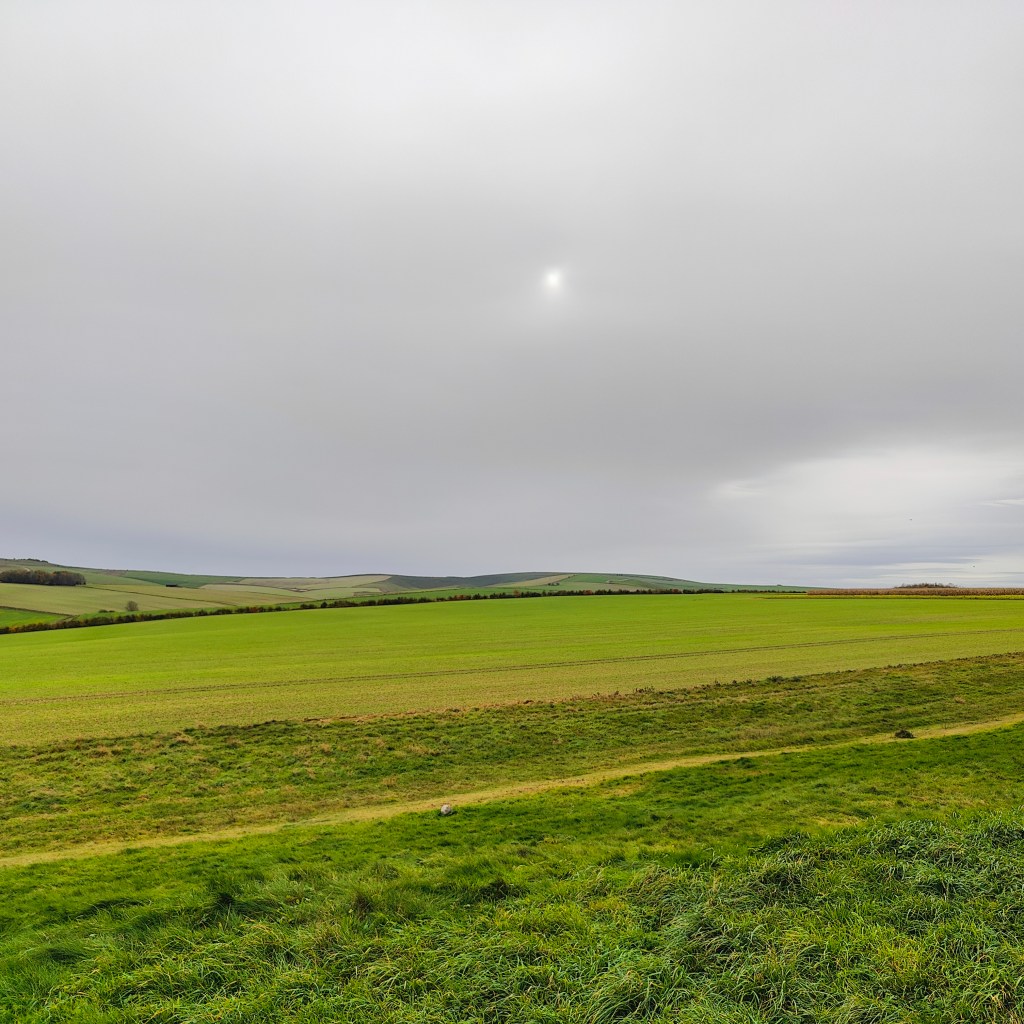
After a quick visit to Stonehenge to refresh on our Stonehenge creative work, we headed to West Kennet Long Barrow to expand our knowledge of the Avebury World Heritage site. The long barrow is on the ridge of a low hill, a ripple on the downs we think of broadly as Salisbury Plain. This landscape has clearly attracted Neolithic people from all over and although beautiful, like much of the varied landscape of the British Isles, some may not necessarily single it out. So it remains a mystery as to why so much effort was made to put up so many exceptional monuments here during neolithic times spanning over millennia. The long barrow was one of the first and used for the burial of human remains.
One thing is very clear to us is that Neolithic and earlier people were intimately aware and connected to the natural landscape, and had a very sophisticated and personal relationship with rock. The open grass plains also seem to have been attractive, perhaps because the contours of the land are more easily appreciated, with open site lines at many vantage points at Avebury caused by the rolling underlying chalk rock landscape.
The area also has fields of glacial deposited stones known as Sarsens. The long barrow at one end is a series of chambers supported by large found stone placements and then covered with soil. Alignments to the sun are apparently important although that was not evident to us on the visit, it wasn’t sunny and the entrance had a big rock in front of it. What seems more interesting to us at this time is how rock makes you feel.

Inside we each had deep but different experiences inside the chambers, shifting perceptions or altering one’s basal state to some extent. Of course its a very subjective thing. Mike: “I found the the atmosphere or energy inside cosy and peaceful, although it would have been cold damp and uncomfortable otherwise, rather like the peace you get with meditation, deep internal. It is the kind of peace that brings harmony, contentment and happiness, and a positive view of ones life.” Lance, on the other hand, found it: “Incredibly unsettling when first entering, but strangely not in a claustrophobic sense. Despite this, I didn’t have the inclination to get out as I have with other confined spaces; something about the space became increasingly intriguing the more I stayed”.
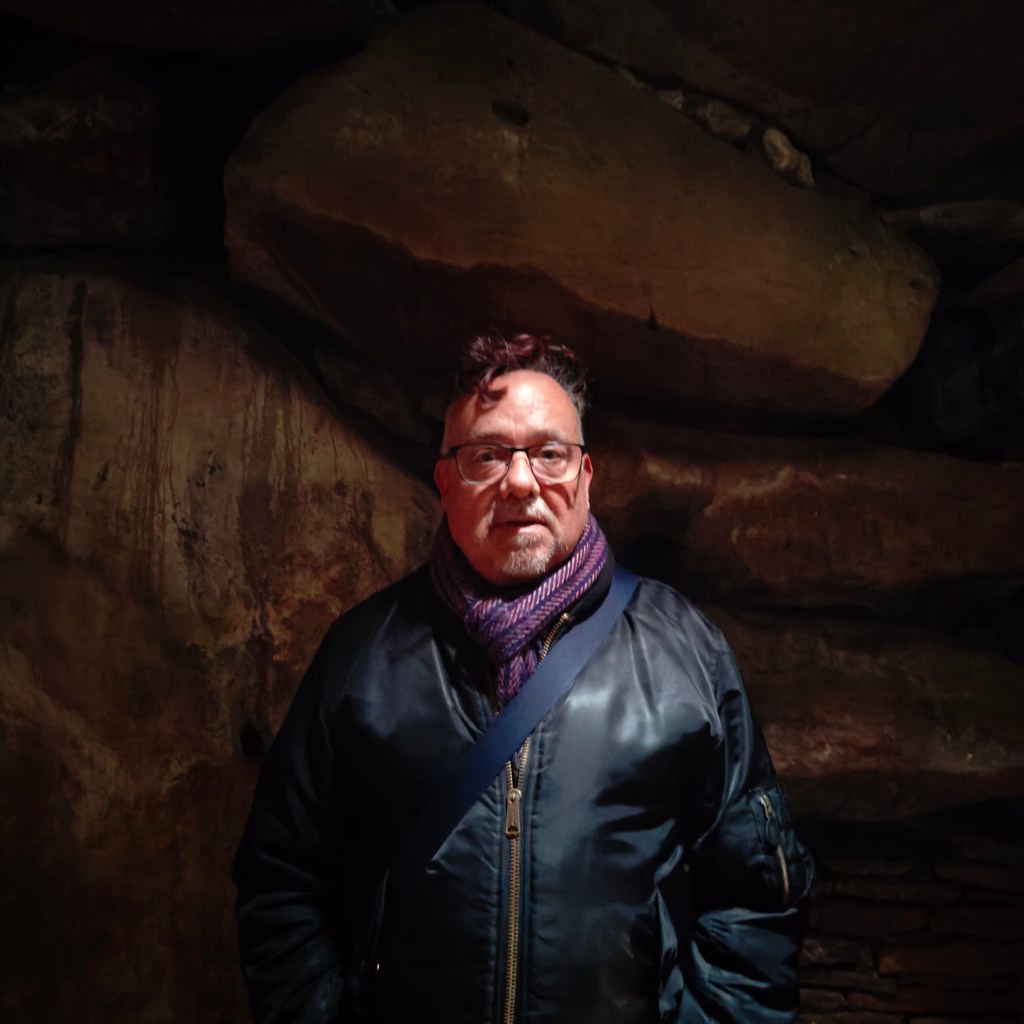
We both noticed at Stonehenge and in the long barrow that this energetic shift, doesn’t happen when there are a lot of people bringing noisy chaotic energy. When away from these kind of people is when that energy seems to be picked up. Mike postulated: “Perhaps, these particular monuments, are like some kind of energy source resonating powerfully but gently, perhaps due to the rocks or arrangements of rocks. Then humans when they are loud and communicating in a very egocentric way disrupts the energy, and makes chaotic eddies that dissipate the energy. When loud children and parents were in the long barrow the energetic, positive and peaceful vibe evaporated. Clearly the other visitors were not picking up on the vibe as we were as they were more focussed on each other or themselves than being in elemental landscape. This reinforces the view for me that modern ways of being and behaving completely cut us off from the deeply wonderful experience of landscape. Neolithic people I believe were naturally deeply connected to landscape for their survival but also their wellbeing. I suspect also some of the aggressive tribal ideas of prehistoric times are often grouped under Celtic, Vikings, Angles etc., people too often remembered for tribal rivalry and warfare, who were less engaged with the landscape and more inward looking protective of family and tribe, like the families visiting the monuments.”
Accounts of the tribes are of course more about bronze, and more notably iron age times, when stone was less essential for survival, so to gradually lose that awareness of stone in the landscape for everyday living. It is possible to see that as a factor in cultural change.
Our explorations of stone monuments and landscape, certainly seem to bring very different experiences, and rock, even that placed in a monumental structure, does not necessarily give rise to these shifts in perceptions or energies, even in quiet and remote places. For example the well kept Rollright stone circle left Mike completely cold much to his surprise. What’s more the experience of these stone energies is something that you cannot remember in full, just an intellectual approximation. So you tend to go away and think it was just imaginary. So revisits are often very surprising when the exact same feelings occur again. When you are in the feeling, it is only then you can remember the previous visits experience in full. Its like the concept of being (in the present), which is not memory or imagination, i.e. the brain thing and being in the past or future. That is of course the stuff generally labelled spiritual experience and writing. The rock experiences are definitely the stuff of “enlightened” modes of consciousness. Awareness of this not something people these days have much experience of. But it does explain why archaeologists perhaps tend to always suggest that monuments may have had some kind of spiritual function, albeit labelled with modern approximations on spirituality, religion, ritual, superstition, birth, death and afterlife beliefs, etc. Although in our view they may be nothing to do with our stone experiences using these modern concepts of religion and what is often beliefs and dogma in pseudo-science in place of religion.
We would both like to make another visit to the West Kennet Long Barrow. But it would need to be without other visitors, so we could explore the resonant qualities of the chambers. Perhaps taking some of Lance’s sound work into the barrow to really test this out.