It was the title of this exhibition held at the Royal Academy in London that caught our imaginations; and at the right time too.
Mike and Lance, having had to put Earthwaves aside temporarily to pour separate energies into all manner of domestic issues, saw the potential of the exhibition as important to inspiring future projects. It had to be seen; so a date was made.
Taken from the Royal Academy’s website:
From climate change to species extinction and resource depletion, the damaging effects of modern life are more tangible than ever. Eco-Visionaries examines humankind’s impact on the planet and presents innovative approaches that reframe our relationship with nature. Through film, installation, architectural models and photography, the works in this exhibition interrogate how architecture, art and design are reacting to a rapidly changing world, beyond mainstream notions of sustainability.
In the 1950s, scientists started raising serious concerns about the damaging effects of modern life on the environment. Since then, architects, designers and artists have joined the urgent effort to draw attention to the planet’s fragile and endangered ecosystem.
This timely exhibition brings together international practitioners including Olafur Eliasson Hon RA, Ant Farm, Alexandra Daisy Ginsberg, Andrés Jaque, Tue Greenfort, Unknown Fields, Rimini Protokoll, Virgil Abloh and WORKac, amongst others. Their provocative responses are a wake-up call, urging us to acknowledge and become conscious of our impact on our environment.
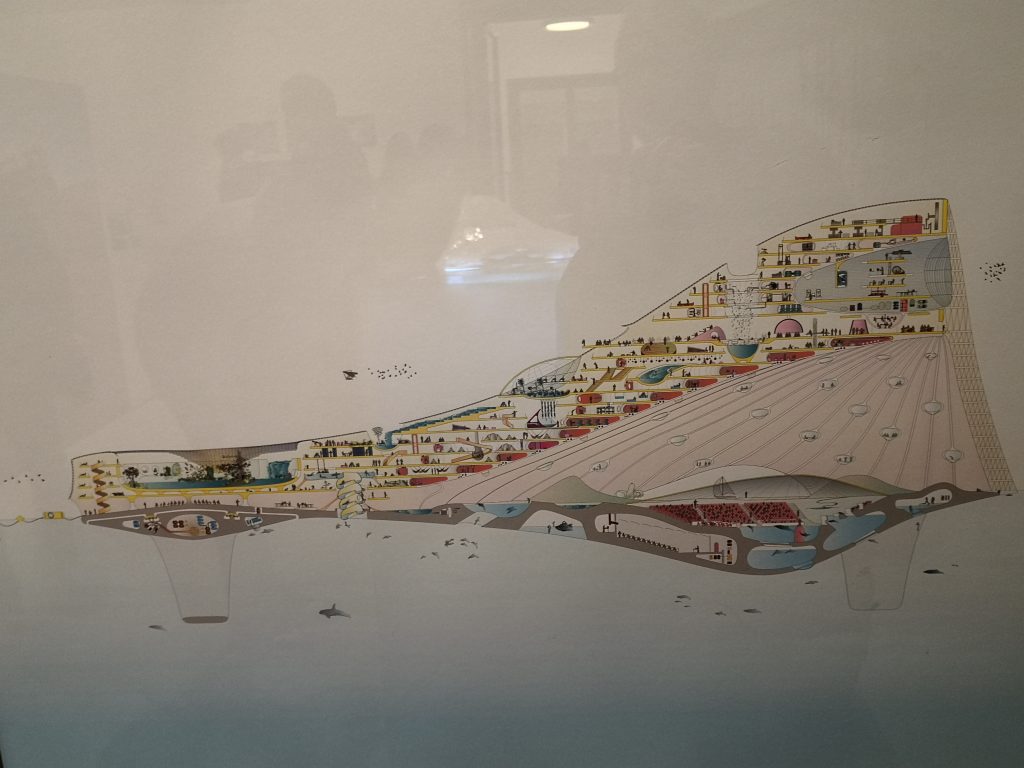
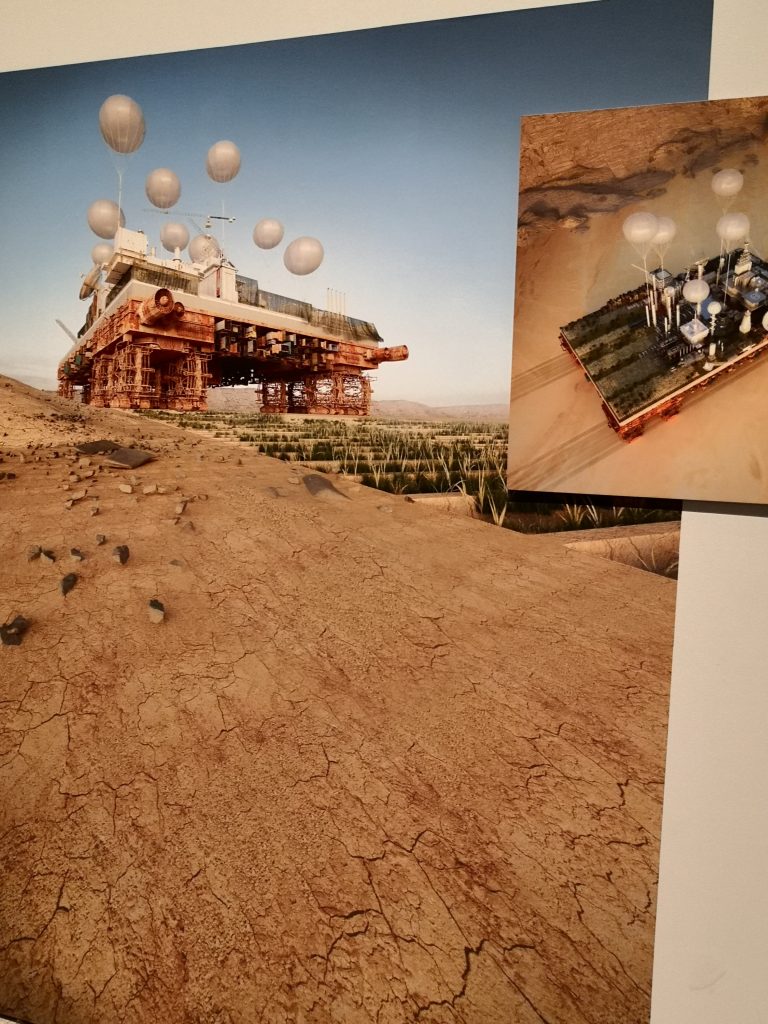
It proved to be a successful visit; not only in the exchange and inspiration of ideas surrounding ecological issues, but also inspired surprising new insights. Who would have thought that jelly fish live forever and are thriving in warmer waters unlike other creatures. Quite complex ideas were presented like the Dolphin Embassy and the use of old oil rigs to regenerate the Sahara Desert, along with simple statements such as the extinct Tilapea fish example, where actual fish were used to make a mono print. As mono printing is a singular printing technique, one unique print every time an impression is made, so this brought to mind finger prints and the notion that the print was like a fossil record after the extinction. Once gone the fish would have no further prints made. The technical presentations of the various works also proved useful, particularly when considering how to stage future installations.
‘Eco-Visionaries’ (now closed) was a brilliantly curated exhibition, featuring excellent works in a number of forms. However, for us, the most impressive was the installation ‘win><win’ by Rimini Protokoll (Helgard Haug, Stefan Kaegi and Daniel Wetzel) – a brilliantly conceived and incredibly clever piece that connected on so many levels. It really had to be experienced to be believed, and to explain further here would be a criminal disservice to the work, where the element of surprise is fundamental.